




Company actual property leaders aren’t brief on information. The more durable drawback is figuring out which indicators are dependable sufficient to drive a portfolio determination.
An workplace can present low common utilization whereas reaching capability midweek. Reserving information can counsel sturdy demand even when precise occupancy tells a distinct story. A location that appears costly on a cost-per-square-foot foundation should still help groups or enterprise features that make it strategically vital.
Throughout a big portfolio, these variations complicate choices about leases, consolidation, funding, and office design.
The Eptura 2025 Office Index discovered that 34% of companies deliberate to extend workplace attendance, whereas two-thirds of organizations had been already managing between six and 40 office applied sciences. CRE groups are being requested to plan for altering office demand whereas making sense of knowledge unfold throughout an more and more sophisticated expertise setting.
The following section of company actual property administration isn’t about gathering extra information. It’s about connecting the correct information nicely sufficient to make assured choices about the place to speculate, the place to consolidate, and tips on how to get extra from the portfolio organizations have already got.
Key takeaways
- Portfolio optimization requires extra context than common occupancy. Peak demand, utilization, reserving, price, and team-level information can reveal very totally different patterns
- Evaluating reserving and occupancy information helps CRE groups separate worker intent from precise office habits
- Related office information creates a stronger basis for lease, consolidation, redesign, and different portfolio situations
- AI could make forecasting and evaluation quicker, however its usefulness is dependent upon dependable information throughout office and actual property programs
- CRE expertise ought to make portfolio questions simpler to reply, not add one other remoted supply of knowledge
Portfolio optimization requires greater than lowering area
For a number of years, a lot of the CRE dialog centered on lowering workplace footprints. That calculation is turning into extra nuanced.
JLL’s 2025 Occupancy Planning Benchmark Report discovered that 73% of CRE leaders prioritize portfolio optimization. The excellence issues as a result of the smallest portfolio isn’t essentially probably the most environment friendly one.
Decreasing area too aggressively can create issues elsewhere. Staff could battle to seek out desks on peak days, assembly rooms can turn into bottlenecks, and groups can lose areas that help particular sorts of work. Organizations can even discover themselves investing in further area later if attendance necessities or headcount change.
The higher query is whether or not every location has the correct quantity and mixture of area for precise demand.
A constructing with 45% common occupancy, for instance, doesn’t robotically have 55% extra capability. Demand could repeatedly exceed 80% on sure days. One ground could possibly be persistently busy whereas one other stays principally empty. Assembly rooms could function close to capability even whereas particular person desks are available.
Monitoring the correct area utilization metrics helps CRE groups perceive these variations. Common utilization, peak utilization, assembly room utilization, desk occupancy, and patterns over time present rather more context than a single building-wide proportion.
Trying under portfolio averages helps groups decide whether or not the correct response is consolidation, reconfiguration, coverage modifications, or no main portfolio change in any respect.
Reserving and occupancy information inform totally different elements of the story
One of many extra helpful comparisons CRE groups could make is between worker intent and precise office habits.
Reserving information exhibits intent. Occupancy information exhibits what occurred.
A constructing could have excessive desk reservations however considerably decrease bodily occupancy as a result of staff e-book areas they don’t finally use. Assembly rooms can seem absolutely booked even whereas check-in or sensor information reveals recurring no-shows.
The reverse can occur, too. Staff could use unreserved areas, inflicting reserving information to understate demand.
Evaluating these datasets offers CRE groups extra context round how staff work together with the office. Understanding the connection between occupancy and utilization information can even assist groups decide whether or not obvious capability issues mirror precise demand or how staff are utilizing the out there area.
Excessive room demand mixed with reasonable constructing occupancy, for instance, could help changing some particular person workstations into collaboration area moderately than lowering the general footprint. Persistent reservation no-shows may justify automated room-release insurance policies. Demand concentrated particularly neighborhoods can point out which environments staff want earlier than office groups put money into a bigger redesign.
The target is to know the habits behind the numbers earlier than making an actual property determination based mostly on them.
Related information makes state of affairs planning extra credible
Think about a lease expiration.
The group may renew your complete area, cut back its footprint, consolidate staff into one other location, relocate, or redesign the prevailing office. Every choice has implications past lease.
CRE groups could must account for:
- Present and projected headcount
- Peak attendance
- Group-level demand
- Current capability
- Lease and working prices
- House configuration
- Deliberate enterprise development
- Sustainability targets
When that data lives in separate programs, groups can spend vital time assembling the baseline earlier than they’ll consider the situations themselves.
Related office and portfolio information shortens that distance.
As an alternative of relying totally on historic headcount ratios, CRE leaders can mannequin what may occur if attendance will increase, a enterprise unit grows, two places consolidate, or a ground is reconfigured.
House planning software program may also help groups work with ground plans, capability, utilization, and allocation information when evaluating these choices. That provides planners extra context earlier than committing capital or coming into one other long-term lease.
A portfolio determination made in the present day could stay in place for years. Situation planning offers CRE leaders a option to account for a office which will proceed altering all through that interval.
Expertise fragmentation is turning into a CRE drawback
Expertise fragmentation isn’t solely an IT concern. It straight impacts how rapidly CRE groups can reply portfolio questions.
The Eptura 2025 Office Index discovered that fifty% of organizations use a median of 17 standalone office options.
These programs could individually carry out their jobs nicely. The issue seems when leaders must reply questions that cross them.
Ought to this lease be renewed? Can two groups match comfortably in a single location? Why is price per worker growing at a specific workplace? May the group surrender a ground with out creating capability issues on peak days?
Answering these questions could require data from area administration, reserving programs, occupancy sensors, HR platforms, entry management, customer administration, upkeep programs, and monetary information.
If groups should manually mix these sources for each evaluation, reporting itself turns into an impediment to decision-making.
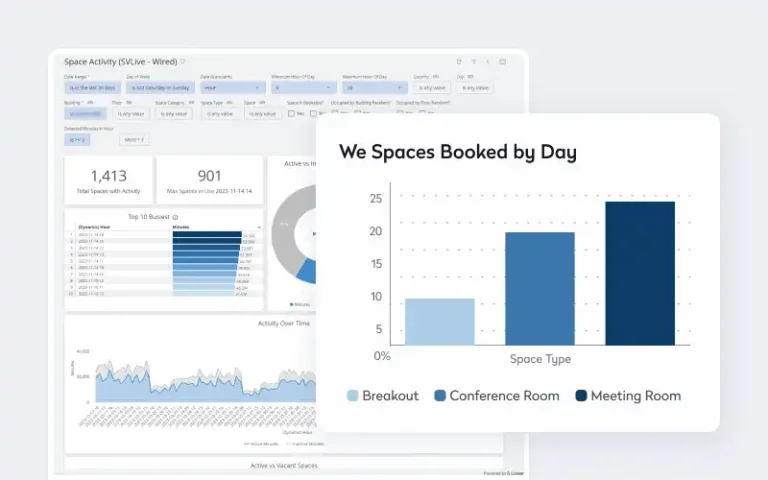
An built-in office administration system can present a extra linked basis by bringing data from totally different areas of the bodily office into a standard setting.
The objective isn’t integration for its personal sake. CRE groups want to have the ability to look at relationships between price, capability, utilization, and worker habits with out rebuilding the dataset each time a brand new query arises.
Office expertise can reveal portfolio issues
Staff expertise CRE choices at a sensible degree.
Can they discover a desk close to their crew? Is the correct assembly area out there? Do they know who plans to be onsite earlier than making the commute? Can they navigate an unfamiliar ground with out losing time?
These could sound like worker expertise questions, however the ensuing habits can present helpful indicators for CRE groups.
Desk and room reservations can present the place staff intend to work. Group coordination instruments add context round attendance patterns. Reserving habits can spotlight which areas appeal to demand and which staff repeatedly keep away from.
If one neighborhood persistently attracts reservations whereas one other stays underused, the reply is probably not lowering general area. The much less common space may want a distinct configuration.
Equally, if staff routinely battle to seek out assembly rooms regardless of comparatively low constructing occupancy, the group could have sufficient sq. footage however the flawed mixture of areas.
Office collaboration instruments may also help staff coordinate workplace days, discover coworkers, and reserve the areas they want. The ensuing exercise additionally offers one other supply of details about how demand strikes via the office.
This connection turns into more and more vital in a hybrid office, the place attendance can range significantly all through the week.
For CRE groups, office friction can generally reveal an area planning drawback earlier than a portfolio dashboard does.
Deliver customer exercise into the broader office image
Staff aren’t the one folks contributing to office demand.
Guests, contractors, distributors, and different visitors can have a significant influence at headquarters, client-facing places, and websites with vital contractor exercise.
Fashionable customer administration offers greater than an environment friendly check-in course of. Digital pre-registration, entry management integrations, customer information, and real-time details about who’s onsite can strengthen safety and emergency preparedness whereas including one other layer of office visibility.
A linked customer administration system can even give office groups higher details about exterior visitors throughout services.
When customer data connects with worker occupancy and entry information, groups have a extra full image of who is definitely utilizing a facility. That context may be significantly worthwhile when evaluating high-traffic places or areas the place exterior guests account for a significant share of demand.
Sustainability choices want utilization context
Portfolio optimization and sustainability planning are more and more linked.
JLL’s 2025 Occupancy Planning Benchmark Report discovered that 74% of organizations have energetic sustainability applications linked to occupancy planning, together with efforts round portfolio rightsizing, waste discount, and furnishings reuse.
The connection is smart. Sustaining, heating, cooling, and lighting area that persistently goes unused carries each monetary and environmental prices.
However sustainability choices face the identical drawback as portfolio choices extra broadly. A low common utilization charge doesn’t essentially imply a constructing or ground can merely be faraway from the portfolio.
CRE groups want sufficient context to know when area is required, who makes use of it, and whether or not demand could possibly be accommodated elsewhere.
Related occupancy and portfolio data may also help organizations establish alternatives to consolidate intelligently, reconfigure current area, or function buildings in another way based mostly on precise demand.
AI is most helpful when the underlying information is linked
AI is creating new alternatives for CRE groups round forecasting, reporting, and discovering patterns throughout giant datasets. However its usefulness is dependent upon what sits beneath it.
Making use of AI to fragmented or inconsistent office data could make evaluation quicker with out essentially making it higher.
Related information creates a stronger place to begin.
AI can then help work equivalent to:
- Figuring out uncommon utilization patterns throughout places
- Forecasting occupancy based mostly on historic habits
- Evaluating portfolio situations
- Automating recurring stories
- Surfacing modifications that warrant nearer investigation
It will probably additionally change how leaders work together with data.
As an alternative of navigating a number of dashboards to find out which places skilled the biggest utilization modifications in the course of the earlier quarter, CRE leaders can more and more use AI-supported analytics to floor related patterns and determine the place deeper investigation is required.
That doesn’t take away the necessity for CRE experience. It reduces the time spent assembling and sorting data so groups can give attention to what the findings imply for the enterprise.
The extra helpful query for organizations evaluating AI isn’t merely whether or not a platform has it. It’s whether or not AI can work throughout sufficient dependable operational information to supply insights leaders can truly use.
Consider CRE expertise across the questions you want answered
An extended characteristic listing issues much less if CRE groups nonetheless can’t reply cross-functional portfolio questions with out exporting information into spreadsheets.
When evaluating company actual property software program, leaders ought to take a look at how simply a platform connects the knowledge wanted for day by day office operations and long-term portfolio planning.
Questions price asking embrace:
- Can we evaluate utilization persistently throughout places?
- Can we see peak demand in addition to averages?
- Can we evaluate reservations with precise occupancy?
- Can we mannequin portfolio and area situations earlier than making modifications?
- Can office data join with different enterprise information?
- Can leaders entry portfolio-wide reporting with out manually consolidating it?
- Can AI work throughout linked datasets moderately than remoted purposes?
Integration with the instruments staff already use issues, too. Eptura has expanded office coordination inside Microsoft 365, serving to organizations join office planning extra carefully with established worker workflows.
The aim of CRE expertise shouldn’t be to create one other place to search for data. It ought to make the selections that observe simpler to defend.
Construct better confidence into the following portfolio determination
Most CRE organizations already know they’ve underused area someplace within the portfolio. They know attendance isn’t evenly distributed all through the week, they usually know office wants have modified.
The tough half is deciding what to do about it.
Giving up area, renewing a lease, redesigning a ground, or consolidating places all carry monetary and operational penalties. These choices turn into more durable when leaders are working from totally different datasets or counting on averages that don’t mirror peak demand.
Related office intelligence permits CRE leaders to ask higher questions: Which areas are performing? What’s driving demand? The place does capability fail to match worker habits? What occurs if attendance, headcount, or enterprise necessities change?
Flip office information into higher portfolio choices
Eptura connects office, services, and actual property data so CRE leaders can see extra of what’s occurring throughout their bodily setting and use that perception to tell portfolio technique.
Discover Eptura’s linked worktech platform to see how linked office intelligence can help extra assured actual property choices.
Continuously Requested Questions

By Erin Sevitz
As Vice President of Content material and Buyer Advertising at Eptura, Erin Sevitz oversees groups liable for offering worktech insights and fascinating 25 million Eptura customers worldwide. With over 10 years in thought management on office administration and the constructed setting, Erin brings deep business information to her position. Beforehand, she led communications for the Worldwide Facility Administration Affiliation, a world nonprofit devoted to skilled growth for office strategists and constructing managers, and served as editor in chief for IFMA’s FMJ journal.